

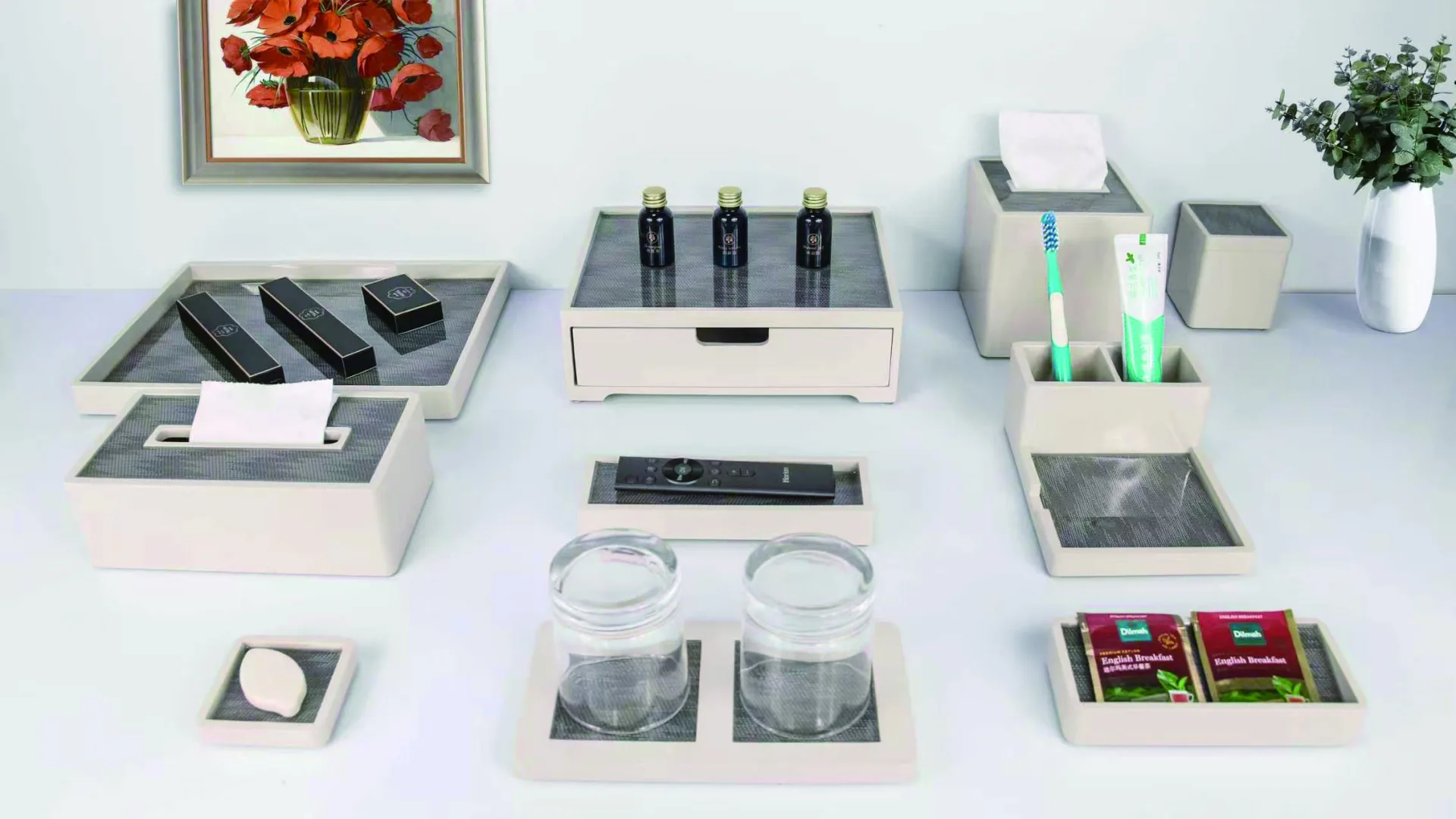
Most hotel amenities ideas start in the wrong place: with one photograph of one beautiful room. The set looks right in that frame. Then it gets multiplied across four room categories, several floors and a reorder cycle that runs for years, and the coordination problem shows up. We cast and hand-finish this product, so we see it from the mold side rather than the front-desk side. A tray photographs well on its own. Fourteen doors in a row is a different test.
The finish is the unit, not the set
A set of six to twelve pieces feels like the thing being purchased. It isn’t. The real unit is the finish. Every model in our polyresin amenity range comes out of its own mold, cures on its own, and is hand-finished piece by piece. Grouping them into a set happens at the packing bench, at the end of the line. Nothing upstream of it knows which items travel together in the same carton.
That single fact rearranges the planning exercise. Splitting a set costs a factory close to nothing. A property that wants five pieces in standard rooms and nine in suites is asking for a packing instruction, not a new product, and a resin bathroom set can be recombined without touching a mold. Adding a finish is the expensive move. New pigment batch, new control samples, another approval round, and a reference tile filed and matched against every reorder for the life of the program.
Let the piece count mark the tier, not the finish
The instinct is to give suites something visibly different. A darker stone. A leather grain. Something that says upgrade at a glance. It reads well on a spec sheet and it fragments the property on the floor.
The version that survives a real building: one finish across every guest room, with the tier expressed in how much lands on the counter. Standard rooms get a compact configuration built around a resin tissue box, a small tray and a bin. Executive rooms add a second resin service tray and an amenity box for sundries. Suites get the full run, including a matching resin trash can in the second bathroom. Guests do not carry a color chip between floors. They register volume, spacing and whether the vanity looks generous. Quantity marks tier more reliably than a finish swap does.
Housekeeping benefits too. One finish means one storage shelf, one replacement pool, one line on the inventory sheet. A bin cracked in a suite gets covered by whatever bin is on the cart. Two finishes turn every breakage into a sorting problem.
What a corridor does that a photograph never does
Product photography uses soft, diffused light from one direction, close in. A corridor of guest rooms uses ceiling downlights, and doors open one after another. Under direct downlight the grain in a stone finish gains contrast. Veining that looked restrained in a studio shot reads harder, and any color temperature gap between two finishes gets amplified rather than flattered.
Put a travertine set in one room and a terrazzo set two doors down. Both rooms are fine on their own. Walk the floor with an owner and it looks unresolved, like the order was assembled from leftovers. Mixed finishes need a reason a guest can perceive: a different building, a floor with its own identity, a spa that is clearly not a guest room. Adjacent rooms are not a reason.
The other half of the mixing problem is physical rather than visual. Pigment is dispersed into the resin before casting, and one batch does not present identically across different shapes. A wide flat tray face shows the color cleanly and slightly cooler. The curved wall of a bin catches its own shadow and reads a half-step deeper. Terrazzo is the fussiest, because the aggregate speckles are mixed into the slurry rather than printed on. Why does a small terrazzo lid look paler than a large body from the same recipe? Fewer flecks land in the smaller area. We raise the aggregate ratio on small parts to compensate, and we approve color against the largest flat face in a set, because that is where a mismatch shows first.
Woodgrain carries a limit worth knowing before it enters a specification. Grain direction has to run somewhere, and on a round bin it meets itself. On square pieces the lines resolve cleanly. Ask to see a round piece and a square piece together, since a flat swatch never shows the join.
So how many finishes does one property actually need?
Usually two. Sometimes one. That answer disappoints people who arrived with a six-panel mood board, and it keeps being right anyway. One primary finish carries every guest room. A second exists only where the guest is obviously somewhere else: a spa, a club lounge, food and beverage service. A third finish is almost always the one ordered in the smallest quantity, reordered least often, and therefore the one that drifts furthest.
Drift is the real argument for restraint. Pigment is mixed by batch, and a batch cast in a single run matches itself perfectly. A batch mixed later against a filed reference tile matches closely rather than exactly. Close is fine when the pieces live in different rooms. Close is not fine when a replacement lands on the same counter as an original. Fewer finishes in circulation means fewer chances for that comparison, which is much of what our finish control process exists to protect.
Reordering so the seam does not show
Quote the original order, and name the finish and the configuration it belonged to. We keep retained samples, and matching to one is the correct default baseline. But the pieces on your floor have been wiped with cleaning chemicals daily for a year or two, and surfaces change under that. If a room can spare one, send a used piece back with the reorder. Matching against a real aged part beats matching against an archive tile, and costs nothing but freight.
Buy the breakage buffer with the main run instead of after it. Pieces cast in the same run from the same pigment batch need no matching at all. They are the same production. A buffer bought later is a new batch by definition, however careful the match. Tray corners and lidded pieces absorb the most abuse in service, so that is where buffer stock pays for itself.
Keep the split documented on your side. Because sets are assembled at packing, we can ship a standard-room configuration and a suite configuration as separate line items under one finish. Someone at the property still has to own what belongs in each. When that lives only in the head of a purchasing manager who later leaves, the second reorder is where it falls apart. Send us your room-type breakdown and we will build the packing lists around it.
Where a coordinated program actually costs money
Branding is where finish choice stops being purely decorative. A logo debossed into the piece during finishing holds up on darker stone patterns, because the shadow in the recess does the work and no cleaning chemical lifts it. Silkscreen on a pale, open-textured travertine surface is a harder ask. That surface has micro-porosity, ink edges soften into it, and fine serifs lose their crispness. It’s worth seeing your mark on the real finish before it is locked into a specification.
Crossing material families raises the same question. Our leather-grain line is polyresin with a pebble texture pressed in during molding, not hide, so it behaves like resin: same durability, same cleaning tolerance, similar weight. It reflects light differently from polished stone, though. Set a leather-grain service tray beside a marble-look tissue box and it doesn’t read as a matching partner. It reads as a second decision. Intentional and zoned, that works. On the same counter by accident, it looks like an error.
The short version, from the side of the bench where these get made: pick one finish and defend it. Vary the count instead. Buy the buffer early. Approve color on the biggest flat surface in the set, and see the awkward geometry before signing. JY Craft plans programs around that logic because it is what keeps a property looking like one property in year three, not only in the launch photography.