

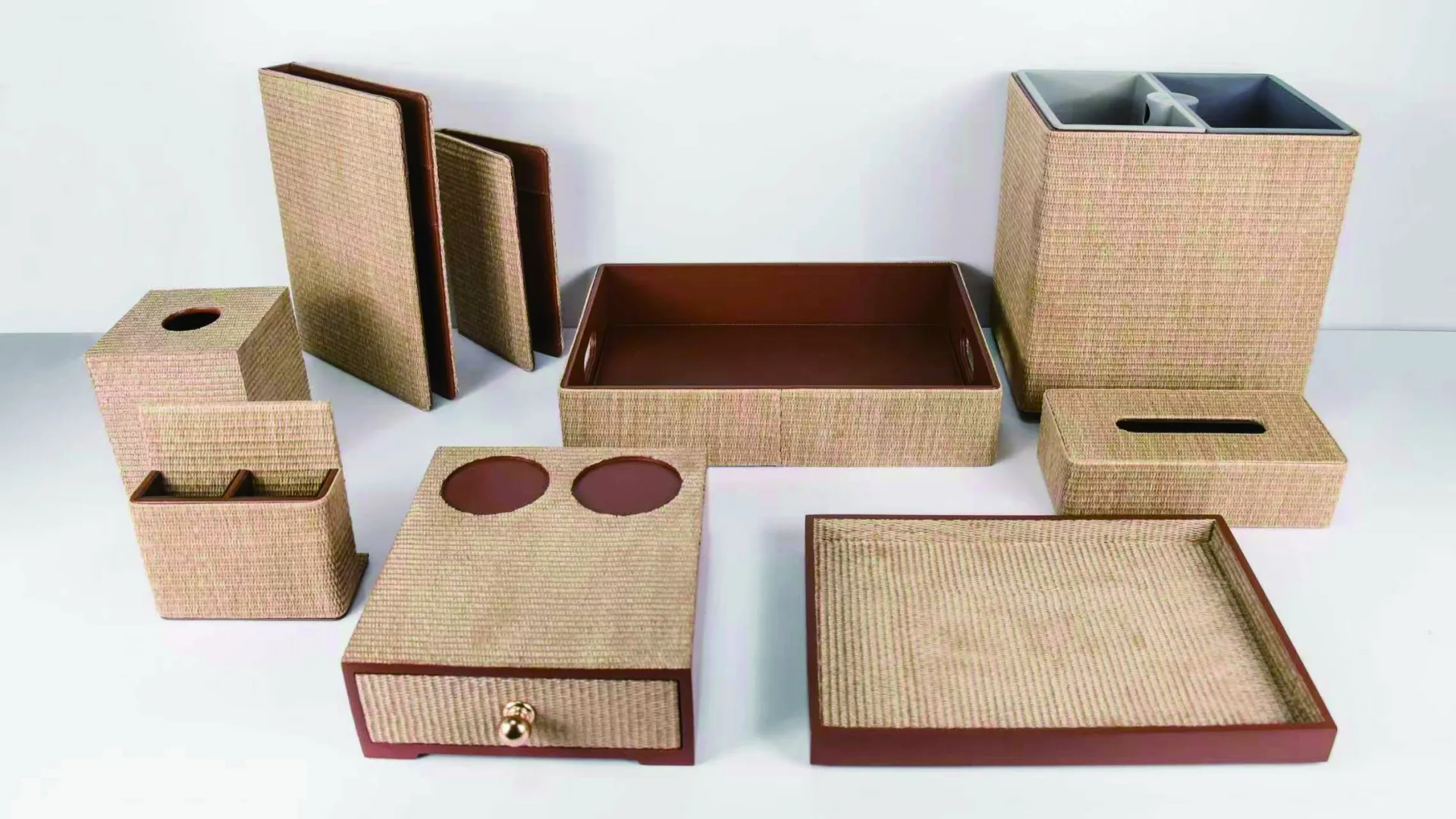
Most versions of a hotel amenities list you find online were written by someone who has never stood next to a mold. They read like inventory sheets. Six pieces here, twelve there, with no explanation of why the number lands where it does. From the factory side the logic is much clearer, because the piece count in a guest room is a tooling and freight decision dressed up as a design decision.
We cast polyresin hotel amenities in Huizhou, demold them, and finish them by hand, and across roughly forty models the same pattern repeats. Standard rooms cluster at six or seven pieces. Suites climb to ten or twelve. The middle is messy. What follows is the reasoning behind those numbers rather than another checklist you could have written yourself.
The six-piece core in a standard room
Walk into a standard room at a mid-market property and the vanity holds the same core group: tissue box, waste bin, tray, soap dish, tumbler holder, lotion dispenser. Add a cotton jar and you have seven. That grouping is what most buyers mean when they specify resin bathroom sets, and it has been stable for years because it covers every function a guest needs without introducing a second large hollow piece.
Why does it stop at six or seven? Because each extra item is a separate mold, a separate cure cycle, and another line on the packing list. A set isn’t one product. It’s six products that happen to share a color batch. Multiply an eighth piece across three hundred rooms and the buyer pays for tooling, resin volume, hand finishing, and carton space all at once.
Cost does not scale evenly with piece count
Here is the part that surprises procurement teams. Two items dominate the cost of any set: the waste bin and the tissue box. Both are hollow, both need real wall thickness to survive housekeeping, and both consume several times the resin of a soap dish. Our resin trash cans are almost always the heaviest item in the carton, and in this material weight is a decent proxy for cost.
A six-piece set and a nine-piece set can land close on price when the three additions are small vanity items. Add a second bin and the gap opens immediately. Buyers who want more perceived generosity per room should add small pieces. Buyers who want a genuinely bigger room presence add volume, and volume costs money twice: once in material, once in freight, because polyresin ships by cube and the largest piece dictates the carton.
Executive floors sit at seven to nine
Club-level and executive rooms usually land between seven and nine pieces, and the additions are predictable. The vanity tray gets upgraded to a proper resin service tray for the welcome amenity. An amenity box appears to hold the sachets and dental kits that used to sit loose in a drawer. Sometimes a second small resin tissue box moves out to the desk or nightstand.
Those three additions do real work for the guest and cost less than most people assume, because a tray is a shallow open form. It demolds quickly, uses little material, and needs less hand finishing on the inside faces. Trays are the cheapest way to add a piece to a room. That is why the count creeps up to nine here instead of jumping straight to twelve.
Suites: where ten to twelve comes from
Suites reach ten or twelve pieces for one structural reason. There are two zones to serve, not one. The bathroom keeps its six-piece core intact. The living area gets its own group: a larger service tray, a bedroom waste bin, a second tissue box, and usually a deeper amenity box for turndown items. That accounts for the extra four to six pieces, and none of them are decorative filler.
The classic suite specification mistake is the second waste bin. Property teams order it in the same size as the bathroom bin to keep tooling simple, which looks efficient on the quotation. Guests then use the living-area bin for food packaging and bottles and it overflows before noon. A taller second bin means more resin and a separate mold, but the alternative is housekeeping emptying it twice a day for the life of the property.
Resorts break both patterns
Resorts and villas rarely follow either count. Placement changes the material conversation before it changes the piece conversation. Direct sun shifts pigment over time, and dark tones show it first, so a deep charcoal terrazzo effect drifts visibly sooner than a pale travertine or a warm sandstone. Poolside pieces also meet sunscreen and chlorine residue, which is harder on a surface finish than anything a bathroom ever throws at it.
For those zones we steer buyers toward lighter stone finishes and away from high gloss, since gloss shows both the chemical hazing and every water spot. Count-wise, resort rooms often run leaner inside and heavier outside: fewer vanity pieces, more trays and bins on the terrace. A villa with an outdoor shower may drop the tumbler holder entirely and take two extra trays instead.
Boutique properties order fewer pieces and fussier finishes
Boutique and design-led hotels are the one segment that routinely orders below six. Four or five pieces, everything else deliberately absent. The catch is that the surviving pieces carry the whole design statement, so the finish specification gets much tighter. Pebble-grain texture pressed into polyresin is popular in this segment, and our leather-look service trays go into these rooms more often than into any other type.
One production detail matters here. The grain in our leather-texture amenity range is pressed from a texture plate, so pattern repeat and grain direction stay consistent within a production run but not necessarily across runs separated by months. A tray and a tissue box sitting together on the same desk should come from the same run. Buyers who reorder a single replacement piece a year later usually notice the difference before their guests do.
What is genuinely non-negotiable
Three items show up in essentially every specification we quote: waste bin, tissue box, and one tray or soap dish. Everything above that is positioning. A cotton jar reads four-star. An amenity box reads five-star. A second tray in the living area reads suite. None of them are functional requirements, and treating them as such burns budget that would do more good as wall thickness in the two pieces guests actually handle roughly.
Replacement orders make the point better than any survey. The two pieces that come back are the bin and the tissue box, by a wide margin. They get dropped, knocked off vanities, and occasionally packed into luggage. Order spares of those two alongside the main run, in the same pigment batch, and store them. Pigment is mixed batch by batch, and a piece cast six months later will sit slightly off-tone next to its neighbors even with an identical color code on the spec sheet.
Three decisions to make before you send a specification
Decide how the logo goes on. Debossing at the mold stage is cheap once the tool exists, but it welds the mark into the tooling. Pad printing or hot stamping after demold stays flexible between orders, though it wears under aggressive cleaning chemicals over a few years. Neither approach is wrong. They fail differently, and the right pick depends on how often your brand identity moves.
Settle the splitting question early. Minimum quantities work per mold, not per set, so pulling three pieces out of an eight-piece design and ordering only those is straightforward as long as each piece justifies its own run. Mixed configurations across room types are completely normal. Buyers who grasp this stop over-ordering pieces nobody wanted.
Decide the finish zone by zone, not property-wide. Stone, terrazzo, wood grain, and cork effects behave differently under sun and cleaning routines, and the casting and finishing steps behind each one are set out on our factory and quality process page. JY Craft quotes by room-type configuration rather than by fixed set count for exactly this reason. Send the room mix and the placement zones, and the piece list writes itself once you talk the configuration through with our team.